What is Market Design?
Markets often evolve as rules and processes that allow individuals to transact to create value. Under certain circumstances, however, markets fail to materialise or are inefficient such that some value- creating transactions do not occur. Recent developments in economics allow new institutions to be designed to mimic the way markets resolve information and incentive problems normally associated with evolved markets. Market design combines insights from game theory and information economics together with common sense and lessons learned from empirical work and experimental analysis to aid in the design and implementation of actual markets.[1] This does not mean that government will not necessarily have a role to play in these markets, but rather, the nature of their role may change.
Why Market Design?
The purpose of market design is to create the institutions that are currently missing in the economy. These institutions are needed to bring about greater efficiencies, greater choice and more effective service delivery in those domains of the economy where markets are missing.
Often people see “markets” as an alternative to government. This is based on a presumption of “free markets”. However, if one takes a broader view of a market to include any transaction, then there are a myriad of possibilities as to how supply and demand may be impacted by regulations, administrative decisions, legislation, perceptions and cultural factors.
The markets which governments are typically involved in are usually those which are subject to some degree of market failure. Markets fail to evolve or are inefficient for a range of reasons. Whilst the existence of public goods/externalities and lack of competition are known to cause market failure, a range of other factors such as information asymmetry, incentive problems, strategic complexities, timing problems, etc. are now known to inhibit the ability of individuals to transact.
A recent example of a large change as a result of market “re-design” is the National Disability Insurance Scheme (NDIS). Here, the policy and legislative changes have involved giving consumers much greater choice by allocating the funding to consumers based on their eligibility and allowing them (or an advocate) to procure the services needed through a competitive market. This key change then has enormous implications for service providers who must then effectively “compete” for the consumers’ dollars, rather than simply relying on block funding and referrals.
What are the Key Elements of Market Design?
Almost all activities can be viewed as transactions. Whether the context is the exchange of a good or service in a market, investment in skill development and training, human organ transplants, or the provision and uptake of services for homeless youth. In each situation, someone requires and values a service and there is a cost of providing the goods or service. In some cases, we do not wish monetary values to be used (e.g. organ transplants) but this and other services clearly are valued by the consumer. Market design is a structured process that is used to develop the architecture of new institutions needed to facilitate transactions that create value measured in monetary or non-monetary terms. It proceeds by identifying the specific impediments that prevent those wishing to consume goods and services from transacting with those able to provide these goods and services.
As noted above, the impediments to transactions can include: revelation of relevant information (e.g. who most needs/values social services?, who is able to supply these services at lowest cost?); timing complexities (how do consumers and producers of goods and services find each other?); strategic complexities (how to mitigate natural tendencies to game a system?); policy complexities (how to guide consumers and producers through often complex rules and processes needed to direct public services to the intended target?); and so on.
Market design can include changes to one or more of a number of key elements. These include:
- The relevant market boundary (i.e. what we understand to be included in a particular market). For example, is the market maintenance for schools, or maintenance for all public facilities or is the market for health transports or non-clinical health transports and community transports;
- Who receives and allocates the funds where those needing services meet specified eligibility criteria;
- How prices are determined, which includes how those who demand services influence the prices paid and those who supply services influence the prices they receive. Often knowledge about what others are prepared to pay and prices at which suppliers are prepared to supply has an important effect on the final price. This can depend on the information revealed in the process of bidding, and the incentives to put forward prices based on expectations of other market players. Both are important aspects of price determination. Note that is some markets, the price may be zero due to legislative constraints (e.g. illegal to sell organs).
- How quantities are determined, which will depend on the above elements, as well as incentives (e.g. make larger profits) or rules (e.g. provide a certain number of services or take responsibility for providing a particular type of service)
Advantages of Allocation through Designed Institutions
In addition to greater choice for consumers, market design can assist in achieving lower costs or better outcomes for consumers/users of services and more effective allocation of available supply. Some designs focus on the value of the service for allocating services to users, while other designs focus on preferences for a particular service in order to better match demand to available supply. The following three examples show actual benefits achieved from market design.
1. Students with Disability Transport Program (Human Services Voucher Markets)
Instead of providing a take-it-or-leave-it bus service that is designed for the benefit of the transport provider (i.e. students needing to sit on a bus for 2 hours each way) it is possible to organise the services provided through a decentralised institution. The objective of a designed market mechanism is to assign travel services to students by allowing a wide range of accredited service providers to compete for long-term contracts to transport children to special schools. Innovations in market design allow government to: harnesses competition and take advantage of coordination between students (leading to lower cost services); and to specifically respond to the individual needs of students and their families (higher quality and client focused services). Even basic trials replacing decentralised transport services for centralised bus services have resulted in significant cost savings (Scope 2011 case study showed $70,000 saving within the trial group).
Estimated annual saving per student: $4,700 pa
2. Kidney Exchange (Matching Markets)
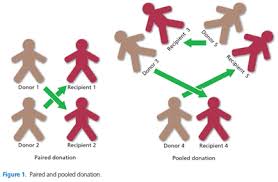
Market design is used to match kidney donors and recipients in a way that optimises live- donor paired donation. Several factors contribute to quality of kidney transplants including: Human Leukocyte Antigen (HLA), blood type and fine scale tissue type are used to match recipients with donors. The best transplant outcome happens when a patient’s HLA and the donor’s HLA closely match. About 70%, or 7 out of 10, patients who need a transplant do not have a suitable donor in their family. If you do not have a donor in your family, transplant teams need to look elsewhere for a suitable match. With market design principles at play, family members can donate to a suitable recipient outside the family and their family member can likewise receive a suitable kidney from a donor outside the family. The 2012 Noble Prize in economics was awarded to Roth and Shapley for developing the structure of matching rules and embedded incentives that lead to more efficient and effective matching of human organ transplants. These ideas also influence the way students are matched to universities, children to kindergartens, graduates to positions, doctors to hospitals etc.
Estimated increase in likelihood of receiving a suitable kidney: Up to a 35% increase, with most of these gains resulting from two- and three-way exchanges.
3. Environmental service (Revealing Information through Auctions)
Markets for environmental services have failed to evolve primarily because ecosystem services are public goods. As a result, these services have been traditionally provided by governments through national parks, regulation on land use (i.e. restrictions on clearing of native vegetation) and through assistance provided to private land-holders to conserve native vegetation. While it is not possible to create a self-funded market for public goods themselves, it has been possible to create institutions that harness competition to cost-effectively supply ecosystem services from private land holders. Designed auctions have been successfully used to discover which land holders can increase the stock of habitat at low cost (the stock of habitat and the supply of ecosystem services are correlated). This approach replaced fixed-price grants and regulation to supply additional units of habitat at a 30% cost saving in Victorian pilots. Initial pilots have led to this approach being used across Victoria for terrestrial and riparian habitat restoration.
Estimated cost savings: 30%
[1] Vulkan, N, Roth, A. and Neeman, Z. (2013), The Handbook of Market Design, Oxford University Press.
 Economic Information Services